
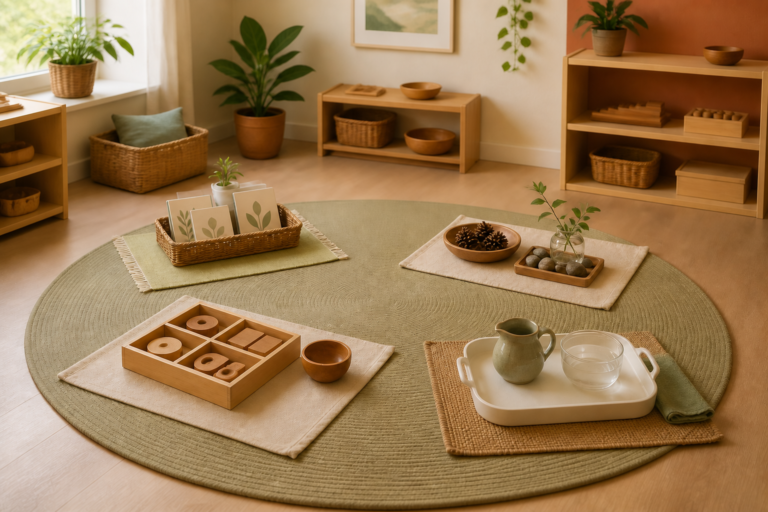
Caring for shared materials is a practical skill children begin learning through repeated everyday experiences. Montessori-inspired environments often invite children to choose, use, return, and care for materials, while adults provide clear limits and helpful demonstrations.
Show one complete cycle
Instead of only saying “put it away,” slowly show how to choose an item, carry it carefully, use it, and return it to the same place. Children often learn best when they can see the whole sequence.
Keep a small number of materials accessible
A low shelf, basket, or tray can make it easier for children to see where an item belongs. Too many choices can make cleanup harder, so rotating a few familiar materials may be more useful than putting everything out at once.
Use child-sized tools when possible
A small cloth, dustpan, or basket can help a preschooler take part in caring for a space. The task does not need to be perfect to be meaningful; the experience is the practice.
Give time for finishing
When a child is deeply involved in an activity, a sudden cleanup request may feel hard. Offer a clear warning and a simple next step so the child has time to complete what they are doing.
Respond to spills calmly
Spills and dropped items are part of learning. Rather than treating them as a problem to hide, adults can show what to do next: get a cloth, wipe the area, and return the cloth when finished.
Value contribution over speed
A child who puts back two pieces, folds one cloth, or carries one tray is practicing responsibility. Small contributions build familiarity over time.
These routines support care for a shared environment while allowing children to practice independence in realistic ways. Families can also review practical questions for a preschool visit when they want to learn more about a program or routine.
Prepare the environment for success
Children can care for materials more easily when each item has a visible home and adults keep expectations consistent. A photo label, an outline on a shelf, or a simple basket can make returning something feel like a concrete task rather than an abstract instruction.
Offer help without taking over
If a tray is heavy or a puzzle is hard to fit back into its box, pause and offer one useful part of the task. You might steady the container while your child places pieces inside. Shared work still lets a child experience the full routine.
Connect care to respect
Simple language can make the purpose clear: “We put this back so another person can find it.” Over time, children begin to see that caring for materials also cares for the people who use the space together.
Keep the next step realistic
With how children learn to care for shared materials, a small repeatable practice is usually more useful than trying to do too much at once. Families can notice what a child already manages, offer just enough support for the next step, and return to the idea on another day. This leaves room for children to be curious, to need help, and to develop in their own time.
Share observations, not pressure
A simple note about what a child enjoyed, avoided, or tried can help adults decide what to offer next. If a question or concern continues, families can talk with the people who know the child’s daily routine. Support works best when it is respectful, practical, and focused on the child in front of you.