
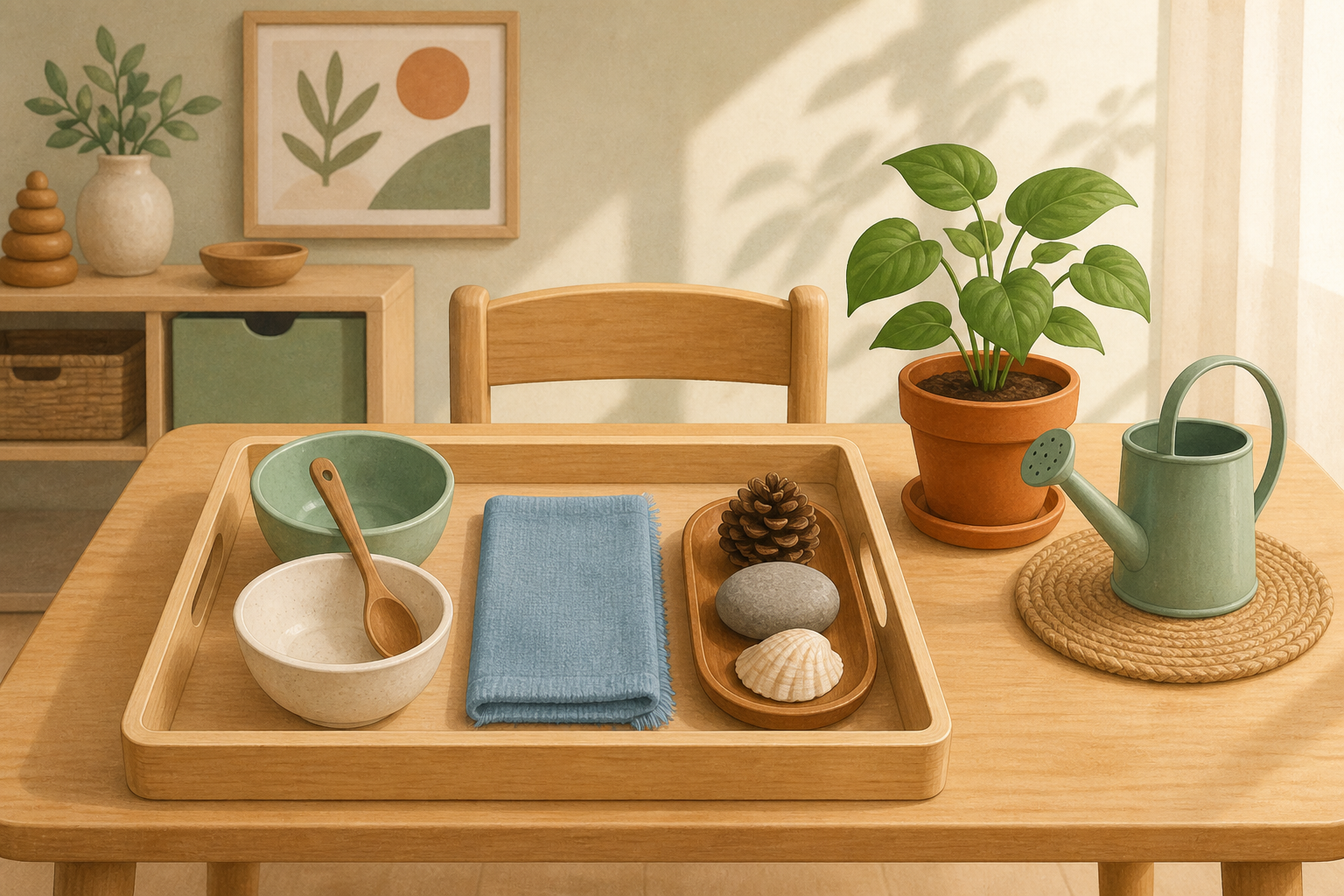
Montessori-inspired learning at home does not require a classroom full of special materials. For children ages 3–5, some of the most meaningful activities can begin with familiar objects, a clear purpose, and enough time to practice. The goal is not a perfect finished product. It is to give children manageable ways to participate, make choices, coordinate their movements, and care for their surroundings.
Choose one activity that fits your child’s current interests and abilities. Demonstrate it slowly, use only a few words, and then let your child try. Stay nearby when safety or cleanup requires adult support, but leave room for effort and repetition.
1. Transfer items between two bowls
Place two small, sturdy bowls on a tray and add a large spoon or scoop. Children can transfer dry pasta, large craft pom-poms, or another age-appropriate material from one bowl to the other. Begin with items that are easy to see and grasp, and avoid anything that could be a choking hazard. This simple activity offers practice with hand control, attention, and working from start to finish.
2. Fold small cloths
Offer two or three washcloths or napkins with clear edges. Show how to smooth one flat, bring two corners together, and place the folded cloth in a basket. A young child’s folds may be uneven, and that is completely fine. Folding connects naturally to everyday family life and can become one of many small opportunities to practice independence.
3. Sort familiar objects
Gather a small collection of safe household or natural objects, such as large lids, fabric squares, pinecones, or smooth stones that are too large to swallow. Invite your child to sort them by color, texture, size, or type. There can be more than one reasonable way to organize a collection. Ask, “How did you decide?” rather than immediately correcting the arrangement. Sorting encourages careful observation and language without turning the moment into a test.
4. Care for a plant
Keep a small watering can or cup near a sturdy houseplant. An adult can show how to check the soil, add a modest amount of water, wipe a spill, and return the tools. Children may also dust broad leaves gently with a soft cloth. Use a non-toxic plant, supervise water use, and place the activity where spills are easy to manage. Caring for something living gives the task a real and understandable purpose.
5. Wash a table or tray
Provide a small bowl with a little water, a sponge, and a drying cloth. Show a simple sequence: wet the sponge, squeeze it, wipe a defined area, dry the surface, and return everything to the tray. Keep cleaning products out of reach; plain water is often enough for practice. This is a classic example of Montessori-inspired Practical Life work because the movements serve a useful everyday need.
Make the activity easier to use independently
A few thoughtful details can help. Arrange all materials together on a tray or in a basket. Offer child-sized tools when possible, limit the number of steps, and keep the activity in a consistent location. If your child becomes frustrated, simplify the task or quietly model one step again. It is also reasonable to put an activity away and return to it another day.
Montessori-inspired home activities work best when they remain connected to real life rather than becoming another set of assignments. Follow your child’s pace, expect spills and imperfect attempts, and choose materials that are safe for your household. With calm repetition, ordinary moments can provide useful opportunities to practice concentration, coordination, responsibility, and growing independence—without expecting every child to develop in the same way or on the same timeline.